Articles

The history of Burma's jade mines, as seen through Western eyes, from the earliest accounts through World War II.
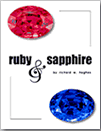
This 1997 classic set a new standard for gemological scholarship. Now out-of-print, it sells for a thousand dollars or more in the secondhand market. Its successor is 2017's Ruby & Sapphire: A Gemologist's Guide.
Part 1 of Chapter 10 from Richard Hughes' 1997 book, Ruby & Sapphire. It covers general principles of judging quality.
Appendix B from Richard Hughes' 1997 book, Ruby & Sapphire, consisting of prices.
This is the chapter on ruby and sapphire from India (including Kashmir sapphire) from Richard Hughes' 1997 book, Ruby & Sapphire.

Inclusions are among the most important features for identifying ruby and sapphire. This is the chapter on ruby and sapphire inclusions from Richard Hughes' 1997 book, Ruby & Sapphire.
The chapter on ruby and sapphire from Burma (Myanmar) from Richard Hughes' 1997 book, Ruby & Sapphire.
Sample sidebar from Ruby & Sapphire (1997) by Richard W. Hughes
Part 2 of Chapter 10 from Richard Hughes' 1997 book, Ruby & Sapphire. It covers record-setting rubies, sapphires and spinels.
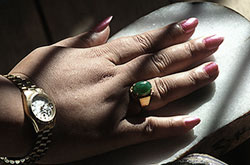
In 1996, several gemologists set off for Burma's remote jade mines, the first visit by foreigners since the early 1960's. This is the story of their epic journey.
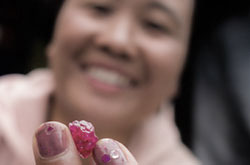
The author makes his first pilgrimage to Burma's Mogok Stone Tract, home of the pigeon's blood ruby.
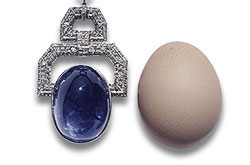
A brief history of Burmese (Myanmar) sapphires, along with details of some of the major pieces of yore.
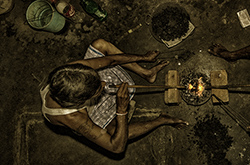
A brief history of the heat treatment of ruby & sapphire, from ancient times to the modern era.
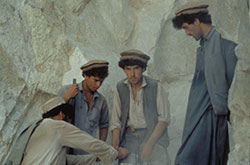
This article discussed the ruby and spinel mines of Afghanistan/Tajikistan, in an attempt to shed light on one of the great gemological enigmas.

The issue of gemological nomenclature is one that has been hotly debated for decades, because an attractive name is a crucial part of marketing and selling gemstones. In this article from 1994, Richard Hughes takes a stab at the subject.

A 1992 visit to Vietnam's Quy Chau ruby mines, the first by a foreign gemologist, along with commentary on US-Vietnam politics.
In 1991, titanium-diffused blue sapphires reappeared in the Bangkok market after an absence of many years. Touted as "deep diffusion," the stones proved to have no greater color penetration than the original Union Carbide product.

This is what happens when someone who knows little about jewelry is asked to write something about jewelry. Richard Hughes tosses off a cheeky description of Thailand's jewelry manufacturing, circa 1990.
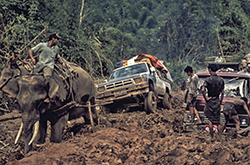
Surface ('bulk') diffusion-treated corundums (SDTCs) created a stir in the Bangkok market in 1990. This article looks at the original patents and continues through the so-called "Deep Diffusion" treatment. Identification methods are discussed, as well as the backroom politics of disclosure. At the end is a quick-reference table summarizing key identifying features of all types of natural, treated and synthetic corundums.
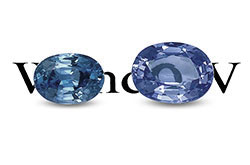
A discussion of brilliance, windows and extinction as they relate to the face-up appearance of colored gemstones. Diagrams demonstrate that extinction is largely a function of cut.